MEDICAL UPDATES
Addressing Prescription Errors, Polypharmacy Risks, and Antimicrobial Stewardship in Modern Medical Practice
Introduction: The Clinical Imperative of Rational Prescribing
The World Health Organization (WHO) defines the Rational Use of Medicines (RUM) as the requirement that patients receive medications appropriate to their clinical needs, in doses that meet their individual requirements, for an adequate period of time, and at the lowest cost to them and their community.
Despite established guidelines, irrational prescribing remains a critical global healthcare challenge. In everyday clinical settings, irrational drug use manifests in several distinct patterns:
- Over-prescription of Antibiotics: Routine administration of broad-spectrum antimicrobials for self-limiting viral infections, accelerating global Antimicrobial Resistance (AMR).
- Uncontrolled Polypharmacy: Co-prescription of multiple active compounds without routine reconciliation, raising the risk of severe Drug-Drug Interactions (DDIs).
- Misuse of Fixed-Dose Combinations (FDCs): Widespread reliance on unapproved or clinically non-additive FDCs, complicating adverse drug reaction (ADR) attribution.
- Under-prescribing of Essential Medicines: Omitting proven primary line therapies due to cost misperceptions or supply chain gaps.
Key Drivers and Systemic Impact of Irrational Drug Use
Understanding the drivers behind irrational prescribing requires evaluating both clinician-level and systemic factors:
WHO Core Prescribing Indicators
To audit and benchmark institutional prescribing habits, healthcare facilities evaluate four primary WHO metrics:
- Average number of medicines per encounter (Target: < 2.0%)
- Percentage of medicines prescribed by generic name (Target: 100%)
- Percentage of encounters with an antibiotic prescribed (Target: < 30%)
- Percentage of encounters with an injection prescribed (Target: < 10%)
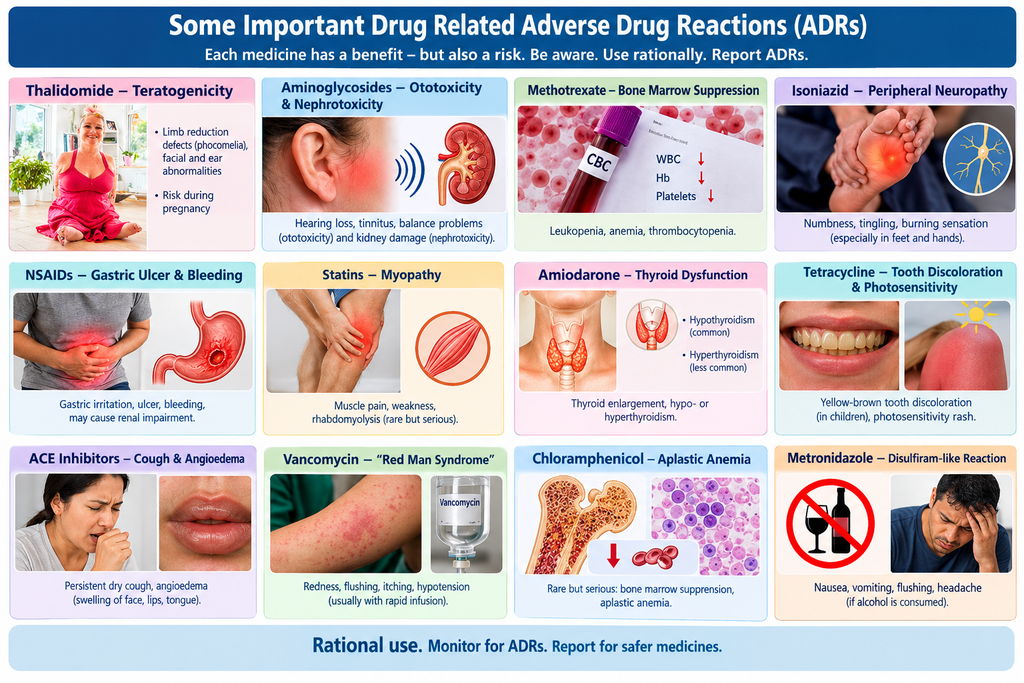
Managing Polypharmacy & Optimizing Patient Outcomes
Multimorbidity in aging populations naturally leads to polypharmacy. However, when medication regimens grow unnecessarily complex, the risk of preventable drug-related hospitalizations increases exponentially.
Actionable Strategies for Clinical Practice
- Adopt Evidence-Based Guidelines: Align hospital formularies strictly with Essential Medicines Lists (EML) and local treatment guidelines.
- Implement Deprescribing Protocols: Utilize validated tools like the STOPP/START criteria or Beers Criteria during every routine inpatient or outpatient review.
- Engage Clinical Pharmacists: Integrate clinical pharmacologists and pharmacists into ward rounds to assist with therapeutic drug monitoring and real-time interaction checks.
- Strengthen Patient Education: Clear instructions regarding duration, adherence, and potential adverse effects significantly reduce patient-driven medication errors.
Pharmacovigilance in India: Safeguarding Public Health through Drug Safety Monitoring
Evolution, Regulatory Framework, and Clinical ADR Reporting Workflows
Introduction & Regulatory Overview
Pharmacovigilance (PV) in India plays a crucial role in post-marketing drug safety, ensuring that pharmaceutical products maintain a favorable risk-benefit ratio throughout their lifecycle. Given India’s vast and diverse population, unique genetic backgrounds, and widespread use of fixed-dose combinations (FDCs), robust adverse drug reaction (ADR) monitoring is vital for patient safety.
The primary governing framework for pharmacovigilance in India is managed through two key bodies:
- Central Drugs Standard Control Organization (CDSCO): The national regulatory authority under the Ministry of Health and Family Welfare (MoHFW) responsible for regulatory decisions, label changes, drug suspensions, and drug recalls.
- Indian Pharmacopoeia Commission (IPC): Functions as the National Coordination Centre (NCC) for the Pharmacovigilance Programme of India (PvPI) based in Ghaziabad, Uttar Pradesh.
Structure of the Pharmacovigilance Programme of India (PvPI)
Launched formally in July 2010, the PvPI operates via a multi-tiered hierarchy designed to capture, validate, and evaluate spontaneous ADR reports across the country:
- National Coordination Centre (NCC – IPC): Oversees data quality, signal detection, risk communication, and recommendations to CDSCO.
- Adverse Drug Reaction Monitoring Centres (AMCs): Located in medical colleges and tertiary hospitals across India (over 300+ recognized centres). They collect, verify, and upload ADR data using VigiFlow.
- WHO Collaborating Centre for International Drug Monitoring (Uppsala Monitoring Centre, Sweden): Receives validated global data submitted by PvPI to enrich the international drug safety database (VigiBase).
Key Clinical Challenges & Opportunities in India
- Under-reporting of ADRs: Spontaneous reporting rates remain lower than target benchmarks, particularly among private practitioners and community pharmacies.
- Fixed-Dose Combinations (FDCs): India has a high market prevalence of FDCs, making signal identification and pinpointing the exact offending active pharmaceutical ingredient (API) complex.
- Polypharmacy & Self-Medication: OTC access to medications complicates causality assessment due to concurrent herb-drug or drug-drug interactions.
- Integration of Digital Health: Transitioning toward automated EHR-integrated reporting systems and utilizing mobile platforms (such as the ADR PvPI app) aims to increase physician participation. MEDICAL UPDATES
ADR Reporting Methods for Healthcare Professionals
Medical updates: Healthcare professionals (doctors, pharmacists, nurses) in India can report suspected ADRs using multiple channels:
- Toll-Free Helpline:
1800-180-3024(Direct line to IPC/PvPI NCC). - Mobile Application: ADR PvPI Android App for quick bedside reporting.
- Official Reporting Forms: Submission of Suspected Adverse Drug Reaction Reporting Forms to nearest AMC or via email (
pvpi.ipcindia@gmail.com).